
The symbolism of the mandala is deeply embedded in the world around us – it's seen in the spiral of a flower, the symmetry of a snowflake, and the intricate structure of a spider’s web.
Perhaps you’ve come across mandalas through art therapy or colouring books. And now you’re wondering – what do mandalas actually mean?
These widely spread symbols carry profound psychological and spiritual significance – keep reading to learn more about how they symbolise:
- The journey to inner wholeness
- The interconnected nature of reality – and our brains
- The perennial philosophy
- The structure of DNA (the most surprising!)
The Journey to Inner Wholeness
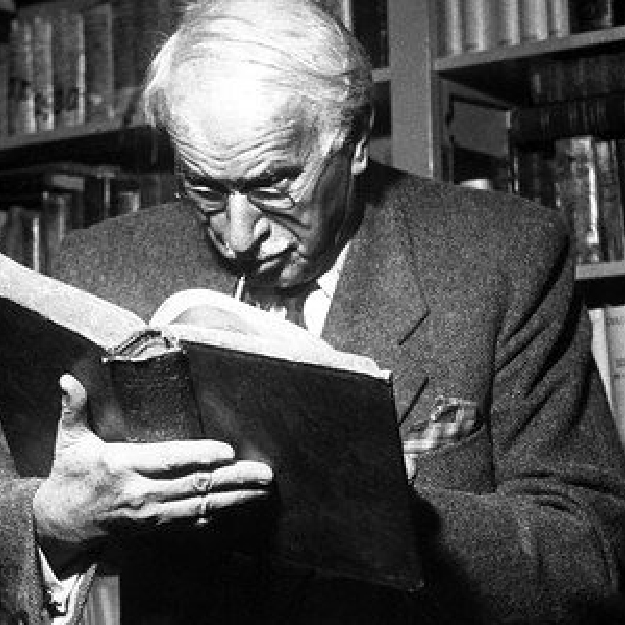
The significance of mandalas extends into psychology through the work of Carl Jung.
Jung noted that his clients would spontaneously draw mandala-like images during times of mental distress. Seeing this, he theorised that the symbol represents the psyche’s natural movement toward balance.
He believed that it symbolised the Self – the integrated totality of conscious and unconscious aspects of the psyche.
In other words: inner wholeness.
Central to inner wholeness in Jungian thought is the concept of the shadow, the unconscious part of ourselves that contains repressed thoughts, desires, and traits we often deny.
Jung believed that ignoring the shadow leads to inner conflict and projection onto others. The journey to wholeness is about recognising, accepting, and integrating the shadow into conscious awareness.
When the shadow is integrated, those hidden aspects lose their power to unconsciously control you. Instead, they become a vital source of authenticity and psychological balance: a process Jung called individuation.
- Did I relate to any examples of the shadow aspects? If so, how might I go about integrating them?
- When do I feel like I'm performing instead of being myself? What aspects of my persona (mask) might it be okay to let go of?
- What irritates me about others, and how might this reflect my shadow?
The Interconnected Nature of Reality – and our Brains
In Buddhism, the principle of dependent origination teaches that all phenomena arise in interdependence. Nothing exists independently or in isolation.
Every event, object, and experience is conditioned by countless other factors.
The mandala beautifully illustrates this principle. Each shape supports and relates to the others; remove one element, and everything shifts.
All things arise, exist, and transform in relationship to the whole.
This same insight is outlined in modern systems theory, which explores how parts of a whole are interconnected.
It emphasises that no element can be fully understood in isolation from the system it belongs to.
Thinkers such as Ludwig von Bertalanffy, who developed General Systems Theory, and Gregory Bateson, who examined patterns of relationships in psychology and ecology, highlighted that change in one part of a system inevitably ripples through the entire network.
This modern theory offers a scientific parallel to dependent origination, reinforcing the idea that reality consists of relational processes continuously influencing each other.
It’s interesting to note how interconnectedness plays out in our own brains in altered states of consciousness.
In Becoming Whole, I describe how I suddenly saw a mandala emerging as I had my eyes closed during deep meditation.
Such mandala visions are a surprisingly common phenomenon reported by meditators. These experiences are associated with patterns of interconnectedness in the brain.
Brain imaging studies of long-term meditators show increased gamma brainwave activity. Gamma brainwaves reflect interconnectedness because they synchronize activity across different brain regions.
When neurons in distant areas fire together in gamma rhythm, the brain combines information from sight, memory, emotion, and attention into a unified experience.
In this short video, psychologist Daniel Goleman explains the astounding brainwave differences seen in long-term meditators.
Similar patterns have also been noted in psychedelic use.
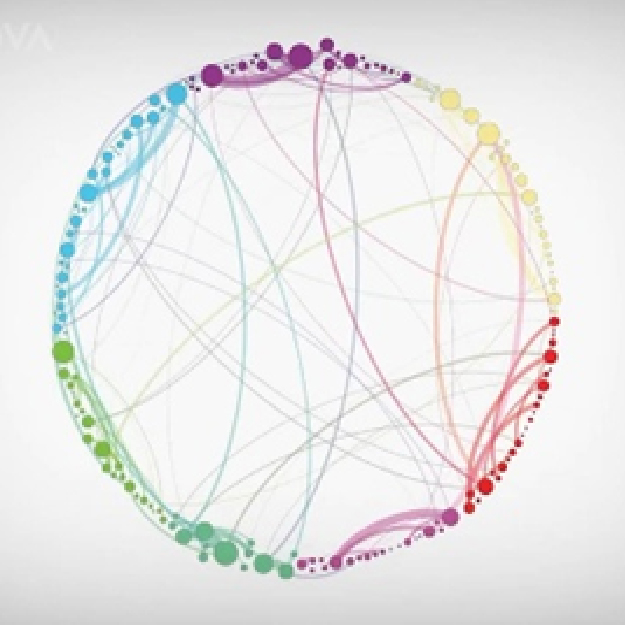
Mathematical model of normal brain activity
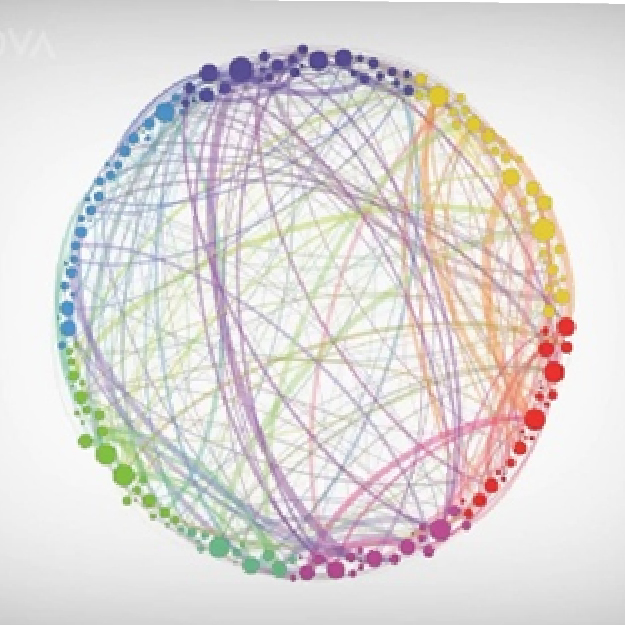
Mathematical model of brain during psychedelic use
Here's another short YouTube video demonstrating this.
These brain patterns may be the biological mirror of what the mandala depicts: many parts coming together to form a unified whole.
The Perennial Philosophy
At the heart of the mandala lies a central point that links all its interconnected elements – the source from which the entire pattern unfolds.
This relates to something called the perennial philosophy – the idea that the recurrence of common themes across the world’s spiritual traditions points to a timeless truth about the nature of reality.
According to the perennial philosophy, these core ideas appear again and again:
- There’s a single, eternal divine source from which all things arise.
- The soul is an expression of that source, temporarily inhabiting a body and capable of remembering its origin.
- The purpose of life is to awaken to this truth.
The mandala can be seen as a visual expression of this.
Its outer layers represent the complexity of the world – forms, identities, thoughts. But no matter how intricate the pattern becomes, everything ultimately traces back to the same centre. Every person, system, and experience is an expression of that same underlying reality, appearing in different forms.
We move through life identifying with the outer layers. Yet many spiritual traditions suggest that beneath all of this is a deeper identity: something already complete.
To journey inward is to move from fragmentation to unity, from distraction to stillness, from separation to connection with the source itself.
The Mandala Structure of DNA
The significance of mandalas even extends to our genetic code.
When we usually picture DNA, we imagine the famous twisting ladder known as the double helix.
But if we look at the molecule from a different angle – slicing it across and viewing it from above – we clearly see a mandala-like pattern.
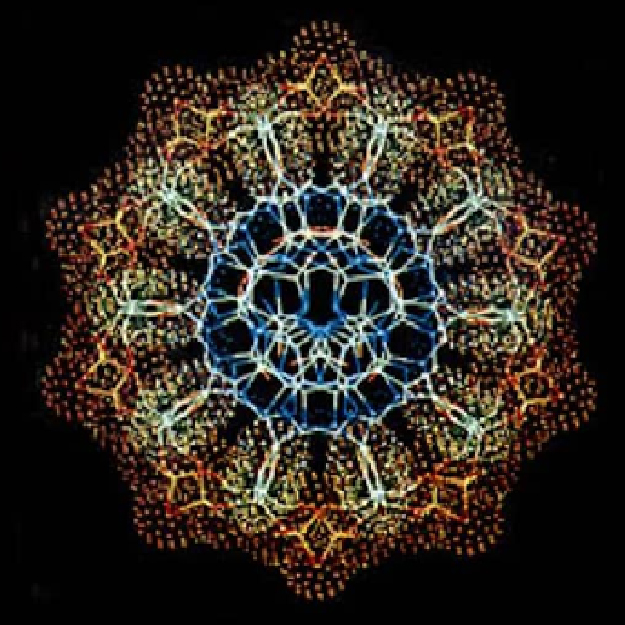
Cross-sectional view from the top of DNA, courtesy of Dr. Robert Langridge
How does this pattern emerge?
It reflects a deeper principle found throughout biology: complex structures often come from very simple rules being repeated over and over.
From the symmetry of snowflakes and the vast spiral patterns of galaxies, simple repeating processes give rise to beautiful forms.
In these systems, all parts are linked, forming a web in which every part contributes to the whole.
Summary
"Nothing in all creation is so like God as stillness." – Meister Eckhart
The symbolism of the mandala appears everywhere around us – from nature and the human psyche to our biology and the underlying structure of society.
It reminds us that life is not a series of isolated events, and that we ourselves are not separate, but part of an interconnected flow of meaning and purpose.
You are part of a greater whole, and that wholeness exists within you.
Through stillness and mindfulness, you can learn to find your way back to the centre.
The sky (your awareness; your higher self) is always clear and vast, even when storm clouds (your thoughts and emotions) are passing through it.
We hope this has given you a deeper understanding of the mandala’s rich symbolism.
May you recognise that you are both the centre and the circle – the source and the expression of something far greater than yourself.
Keep Learning
Interested in learning how mandalas connect to Hermetic principles and more timeless spiritual wisdom?
Want to explore the perennial philosophy in more detail?
Curious about the core themes shared across spiritual traditions?
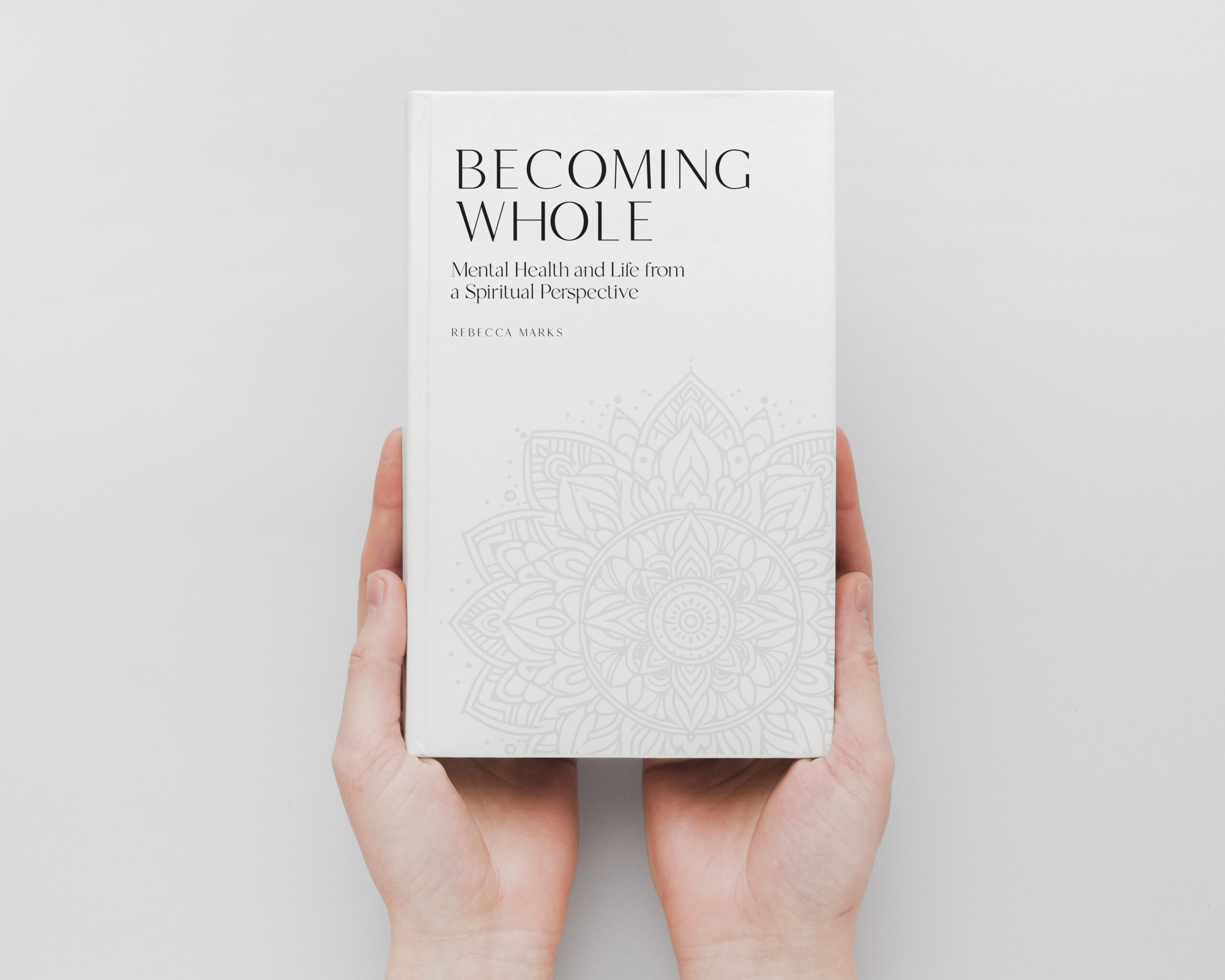
Becoming Whole explores these concepts, bridging ancient wisdom with modern understanding.
It offers a structured way to explore spirituality that acknowledges trauma, respects your intellect, and gives you actionable tools to grow.
- Explore ancient spiritual teachings from Vedic thought, Taoism, Buddhism, Hermeticism, Sufism, Kabbalah, Christian mysticism, and Gnosticism.
- Reduce anxiety and mental distress by connecting with a larger reality.
- Cultivate meaning and purpose by seeing your life as a hero’s journey.
Click here to find out how it can help you nurture your spirituality.


About Rebecca
Rebecca Marks is the founder of The Wellness Society, a social enterprise that has supported thousands on their journey to mental wellbeing.
Her tools have been shared by the NHS and featured by Mind, the UK’s leading mental health charity. She comes from a career in mental health charity management, facilitating peer support programs and co-producing initiatives with service users.
Learn more about our story on the About page.