In this practical, fluff-free online guide to Buddhism, we’ll outline:
- The story of the Buddha
- What his philosophy focuses on: The Four Noble Truths and The Noble Eightfold Path
- Key Buddhist texts (and where to read them for free online)
- The 3 main branches of Buddhism
- 5 practical ways to start applying Buddhist teachings today
Are you ready?
Let’s begin.
The Story of Siddhartha Gautama
Siddhartha Gautama lived around the 5th century BCE (around 2,500 years ago) in what’s now known as Nepal.
He was born into a royal family and grew up surrounded by privilege. His life changed when he encountered the Four Sights:
- An old man
- A sick person
- A corpse
- A holy man
These encounters showed him the stark realities of aging, illness, and death – experiences his family had tried hard to shelter him from.
Disturbed by the inevitability of suffering, Siddhartha left his palace life in search of a deeper understanding of human existence.
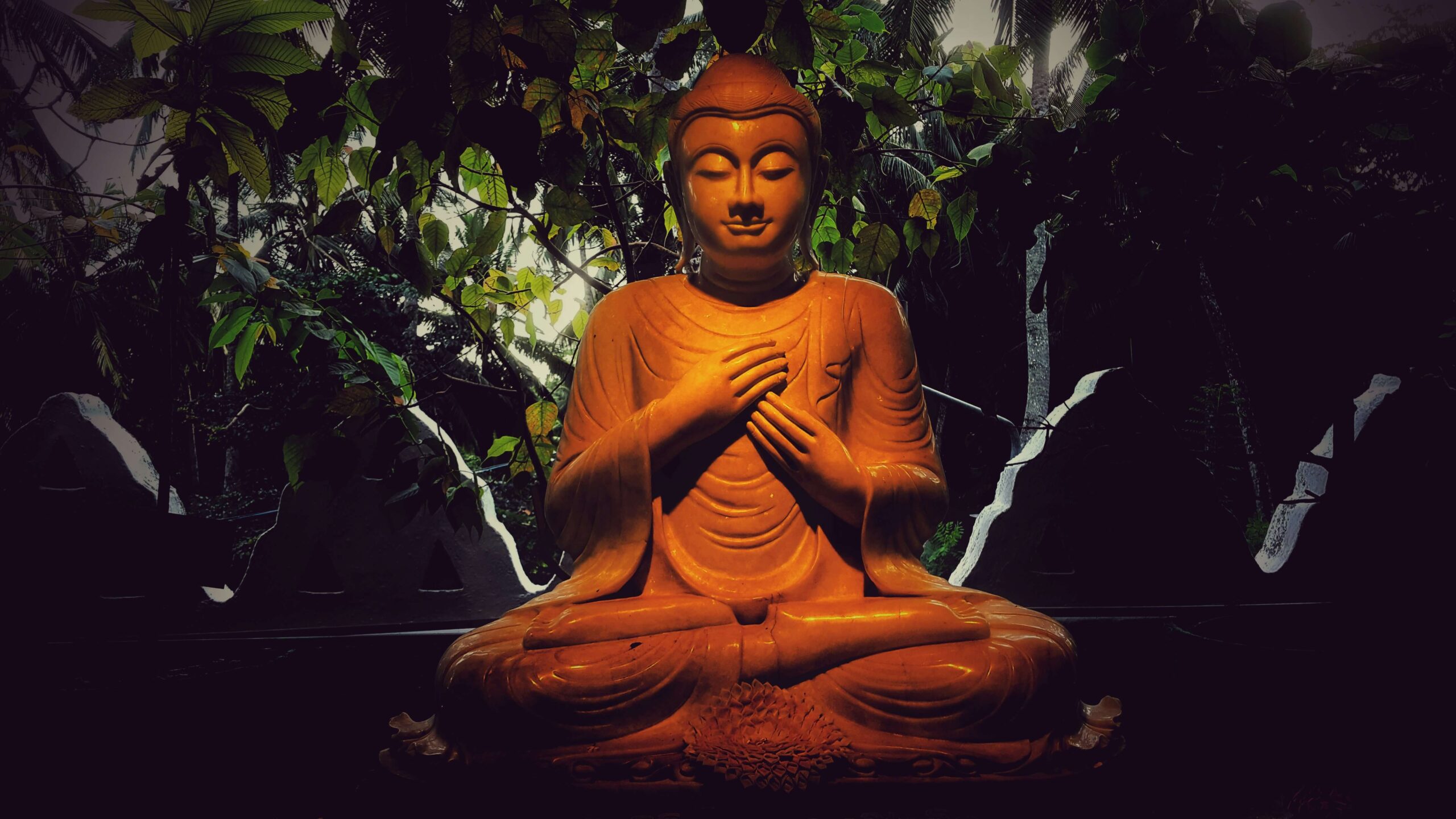
After years of meditation, he’s said to have attained enlightenment while meditating beneath a fig tree (later called the Bodhi tree). From that point on, he became known as the Buddha, meaning “the awakened one.”
For the rest of his life, he travelled and taught a path aimed at understanding and reducing suffering.
What Do Buddha’s Teachings Focus On?
At its core, Buddhism is about understanding the nature of reality.
The Buddha’s teachings primarily focus on The Four Noble Truths:
- The truth of suffering (dukkha). Life involves suffering. This includes obvious pain (aging, sickness, death) but also subtle dissatisfaction in everyday life.
- The truth of the cause of suffering (samudaya). Suffering is caused by craving and attachment; we have a deep-seated mental habit of clinging to pleasure, pushing away pain, and wanting things, people, and situations to be permanent when they’re not.
- The truth of the end of suffering (nirodha). It’s possible to end this suffering. By letting go of craving and attachment, we can experience a state of inner peace (called nirvana or nibbana).
- The truth of the path (magga). There’s a way to end suffering – the Noble Eightfold Path.
The Noble Eightfold Path
The Noble Eightfold Path is a practical guide for reducing suffering and progressing toward enlightenment.
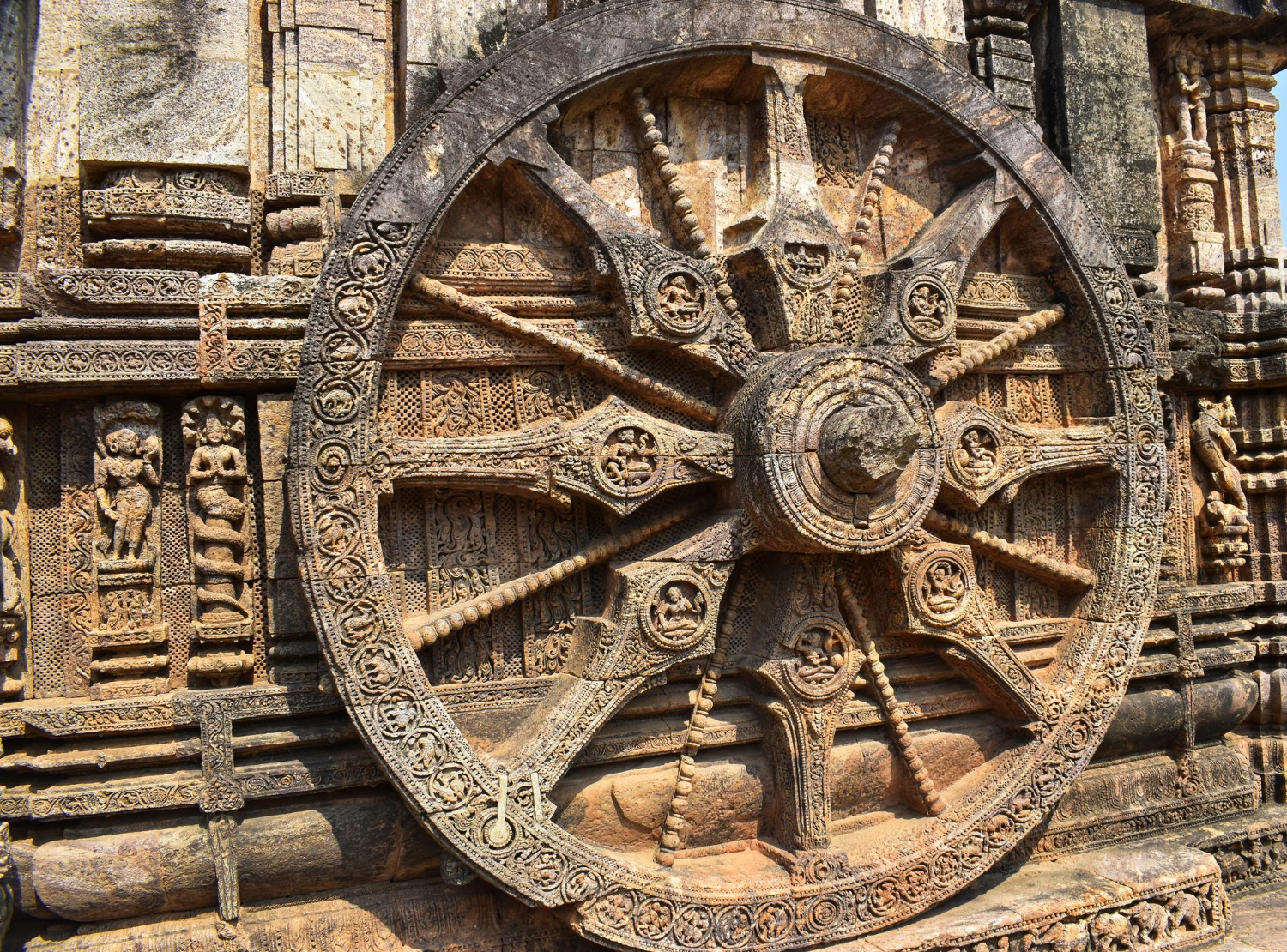
It’s symbolised by the Dharma Wheel, with the eight spokes representing the eight aspects of the path.
Just as the spokes allow the wheel to move forward, these eight practices work together to guide us toward greater wisdom, ethical conduct, and mental discipline.
Rather than steps to be completed one after another, they’re meant to be cultivated together in daily life.
- Right view (Samma Ditthi). This is the foundation of the entire path. It means understanding things as they truly are – having a clear grasp of the Four Noble Truths.
- Right intention (Samma Sankappa). This means resolving to act out of goodwill rather than ill will. It sets the ethical direction for our lives.
- Right speech (Samma Vaca). This means abstaining from lying, harsh words, and gossip; speaking what is true and helpful.
- Right action (Samma Kammanta). This is the ethical guideline for how we behave in the world through our bodies. It includes refraining from taking life, stealing, and sexual misconduct.
- Right livelihood (Samma Ajiva). This means earning a living in a way that doesn’t conflict with the principles of the path.
- Right effort (Samma Vayama). This includes preventing unwholesome states (like greed and anger) and cultivating wholesome ones (like generosity and compassion).
- Right mindfulness (Samma Sati). This is the ability to be aware of the present moment clearly and without attachment. It’s traditionally cultivated through four foundations: mindfulness of the body (like the breath), mindfulness of feelings (sensations, whether pleasant, unpleasant, or neutral), mindfulness of the mind, and mindfulness of dharma (the principles that govern reality).
- Right concentration (Samma Samadhi). This is the focused, one-pointed state of mind that comes from deep meditation. It’s often described as the four jhanasor stages of absorption, where the mind becomes fully unified.
Understanding Key Buddhist Texts
Understanding Buddhist texts can feel confusing at first because there isn’t just one “Buddhist bible.”
Different traditions preserved different collections of teachings over thousands of years. The easiest way to understand them is to think of them in two primary layers: early teachings and later philosophical texts.
Early Teachings
The earliest surviving teachings are preserved in the Pali Canon, also called the Tipitaka (“Three Baskets”). It consists of three sections:
- Vinaya Pitaka. This section includes guidelines for monks and nuns, mostly about discipline and community life.
- Sutta Pitaka. This is where most sayings of the Buddha are found. Important collections inside it include: Dhammapada, Majjhima Nikaya, Digha Nikaya, and Samyutta Nikaya.
- Abhidhamma Pitaka. This section involves more analytical teachings explaining how the mind works.
Later Philosophical Texts
Several centuries after the Buddha, new traditions developed. These produced additional scriptures known as Mahayana sutras.
Examples include:
- Prajñāpāramitā Sutras. A large collection of texts on the perfection of wisdom, including the Heart Sutra.
- Lotus Sutra. This text is a major Mahayana text that teaches the universality of Buddhahood, the Bodhisattva path, and uses parables to convey its message.
These texts explore deeper philosophical ideas such emptiness (śūnyatā) – the idea that all phenomena lack an independent, permanent essence, existing only in dependence on other causes and conditions.
In Tibetan Buddhism (Vajrayana), there’s an extra set of texts called the Tantras. These books focus on rituals, meditation practices, and visualisations.
The Three Main Branches of Buddhism
Just as Buddhism has no single bible, it also has no single institution. Over centuries, it evolved into three major philosophical branches outlined in the table below:
|
Branch |
Region |
Key Texts |
Focus |
|
Theravāda |
Sri Lanka, SE Asia |
Pali Canon |
Earliest teachings, monastic discipline, meditation |
|
Mahayana |
China, Japan, Korea |
Mahayana Sutras |
Compassion, Bodhisattva path, wisdom |
|
Vajrayana |
Tibet, Bhutan |
Mahayana Sutras, Tantras |
Rituals, meditation practices, visualisations |
5 Ways to Start Applying Buddhist Philosophy
So, Buddhist ideas resonate with you. But how can you start applying them in practical ways that make a real difference in your everyday life?
Here are five simple ideas:
1. Cultivate General Mindful Awareness
A very concise definition of mindfulness is perception without language.
Try this mode of being now. Pick an object close to you and try to just observe it without labelling it. Notice the colours, shape, and size, but don’t make any internal judgements about its appearance or utility.
This practice is called Shoshin (初心), meaning “Beginner's Mind”. It refers to having an attitude of openness and lack of preconceptions when studying a subject, just as a beginner would.
Cultivating general mindful awareness means incorporating more “beginner’s mind” moments into your day-to-day life. Mindfulness doesn’t have to start with formal meditation – you can begin by getting into this habit of simply noticing your surroundings, thoughts, and feelings in a non-judgemental way.
2. Experiment with Meditation Techniques
Siddhartha Gautama gained his insights through deep meditation, so it naturally became a highly recommended practice within the Buddhist path.
There are many different approaches when it comes to how to meditate. It’s about experimenting and discovering what works best for you.
In The Mindfulness Journal, we outline multiple techniques, such as:
- Mindful Breathing Meditation
- Sound Meditation
- Mantra Meditation
- Body Scan Meditation
- Progressive Muscle Relaxation (PMR)
- Loving-Kindness Meditation (LKM)
- Visualisation Meditation
- Vipassana Meditation
The key is consistency rather than duration. Short daily sessions can be more effective than occasional longer ones. Experiment and find a style that resonates with you.
3. Cultivate Intention Through Journaling
Ultimately, the Buddhist path is one of intentionality.
It’s about living with awareness and aligning your thoughts, speech, and actions with values that reduce suffering and cultivate compassion.
Journaling helps you cultivate intentionality by creating a space for honest self-reflection. You can use it in a way which helps you become more familiar with the Four Noble Truths and The Eightfold Noble Path.
Doing so deepens your self-awareness and provides a record of your personal (and spiritual) growth over time.
Here’s a list of journal prompts you could use:
- What truths about impermanence have I noticed in my life recently?
- What desires or cravings feel particularly 'sticky' right now?
- When was the last time I acted from anger, and how could I respond differently?
- Which wholesome qualities (i.e., kindness, compassion, equanimity) do I want to strengthen? How might I go about this?
- How can I cultivate more compassion for myself and others this week?
- What steps can I take to cultivate mindfulness?
- What's one routine activity I can do today which I could apply “beginner’s mind” to?
- How can I persevere through challenges without becoming attached to results?
- How could I practice generosity this week?
- How could I bring more kindness into my interactions with others?
- When was the last time I spoke impulsively? What effect did it have?
- What’s a new meditation technique I could try?
- In what ways does my work or daily activity contribute to the wellbeing of myself or others?
- How does my work align with my values?
- Do I engage in any activities that feel misaligned with my conscience?
4. Find a Local Buddhist Temple
Want a tangible connection to Buddhist practice, community, and guidance? Visiting your local temple is a great idea.
At a temple, you can observe how Buddhist principles are applied in daily life and gain insight from experienced practitioners.
Many offer workshops, retreats, and volunteer opportunities. Why not reach out to one and ask about the beginner-friendly services they offer?
5. Listen to Dhamma Talks
Dhamma talks are recorded teachings by Buddhist teachers that explore the principles of the Buddha’s philosophy and how to apply them in daily life.
Many talks are available online for free, covering a wide range of topics – from mindfulness and compassion to dealing with stress or cultivating wisdom.
Why not listen to them during your commute, while walking, or doing household chores?
Dhammatalks.org has a large archive of dhamma talks to explore.
“Dharma” is widely used in Hinduism and Sanskrit scholarship, whereas “Dhamma” appears in Pali texts.
Summary
Buddhism began with the story of Siddhartha Gautama, who walked away from a life of luxury to seek a way to end suffering. His path to liberation is based on understanding and applying the Four Noble Truths and the Noble Eightfold Path.
Many key Buddhist texts are available for free online, offering accessible ways to study and reflect on the teachings:
- Vinaya Pitaka
- Dhammapada
- Majjhima Nikaya
- Digha Nikaya
- Samyutta Nikaya
- Abhidhamma Pitaka
- Heart Sutra
- Lotus Sutra
Simple, practical steps to apply Buddhist principles include:
- Cultivating general mindful awareness
- Experimenting with meditation techniques
- Engaging in self-reflection through journaling
- Visiting a local Buddhist temple
- Listening to dhamma talks
We hope you found this fluff-free online guide helpful, and we wish you the all the best on your journey toward a calmer, clearer, and more compassionate life.
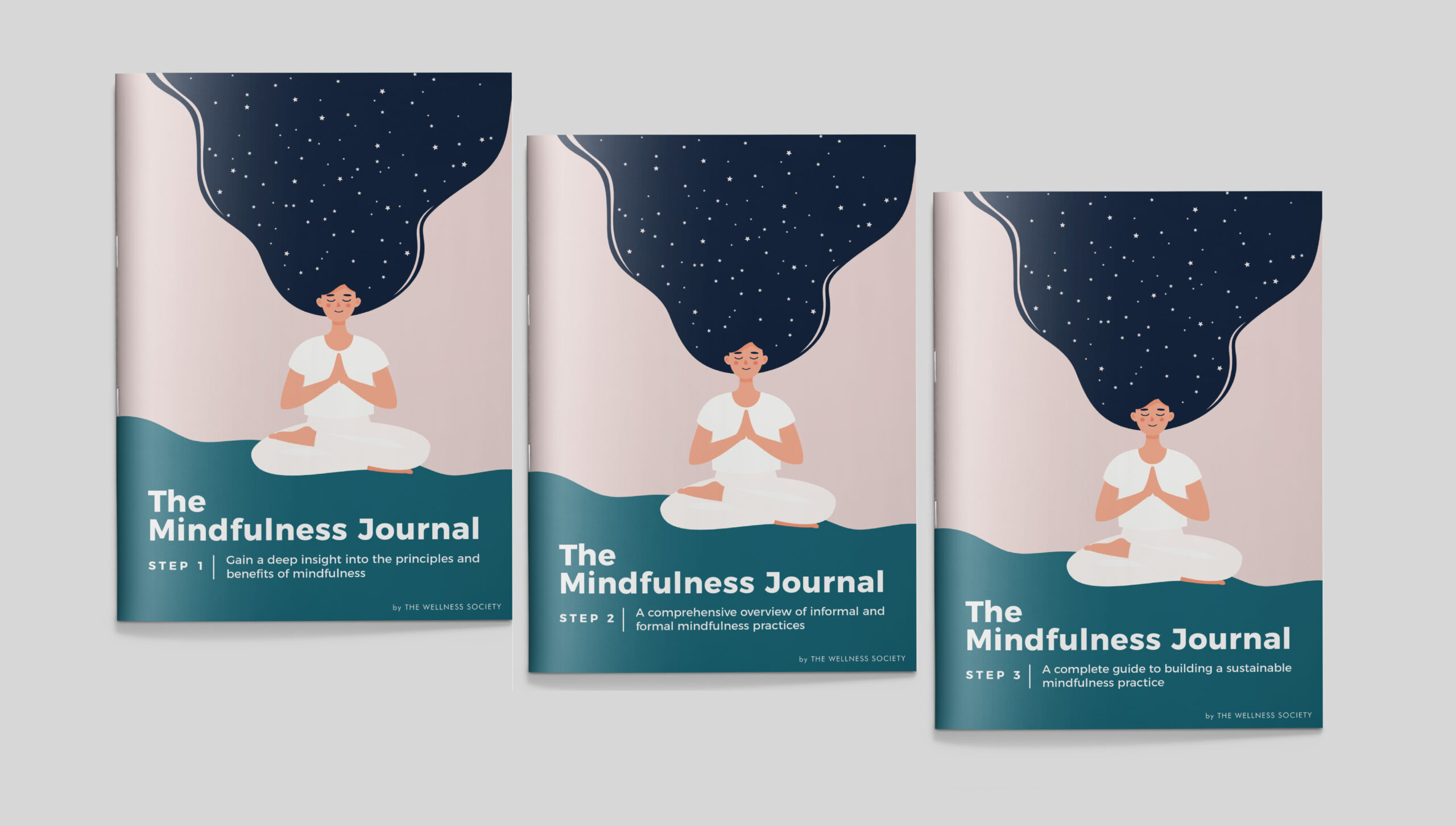
Apply Buddhist Teachings With The Mindfulness Journal
The Mindfulness Journal is a practical, comprehensive tool designed to support your mindfulness and meditation journey, whether you’re new to these practices or an experienced practitioner.
With clear guidance, bite-sized sections, and evidence-based exercises, it’s ideal for anyone wanting to bring the benefits of mindfulness – the essence of Buddhist practice – into daily life.



About Rebecca
Rebecca Marks is the founder of The Wellness Society, a social enterprise that has supported thousands on their journey to mental wellbeing.
Her tools have been shared by the NHS and featured by Mind, the UK’s leading mental health charity. She comes from a career in mental health charity management, facilitating peer support programs and co-producing initiatives with service users.
Learn more about our story on the About page.
Save for Later