
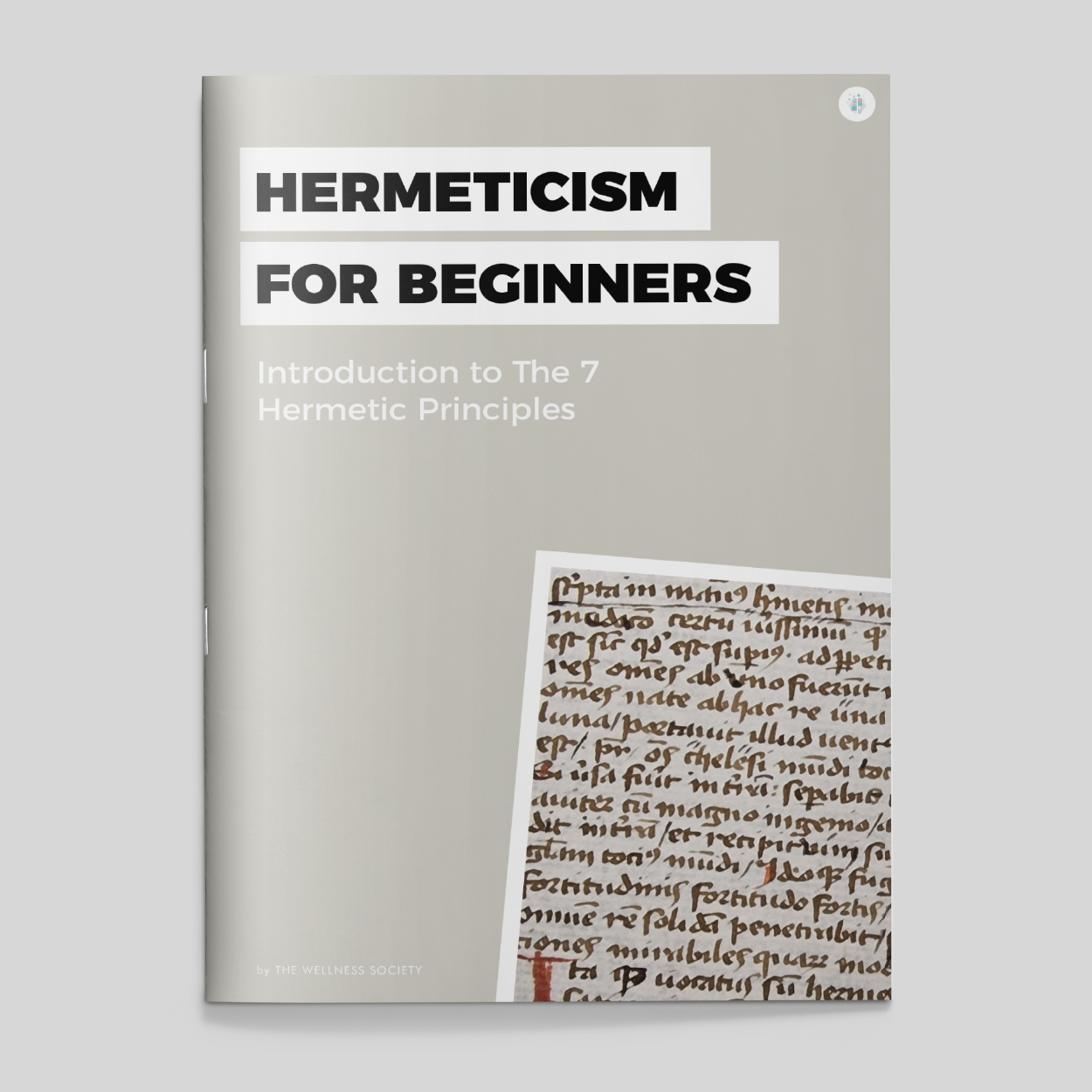
Did you know that many modern personal development ideas are rooted in ancient Hermetic principles?
In this fluff-free online guide, we’ll explore these ideas in a simple, practical way.
We’ll start by tracing its origins and how Hermeticism evolved over time. From there, we’ll break down the seven Hermetic principles you’ll most often encounter, using direct quotes to stay close to the source.
We’ll explore how these teachings connect to mental wellbeing – and what it looks like to apply them in everyday life. Finally, we’ll point you toward the key Hermetic texts and where you can read them for free online.
What is Hermeticism?
Hermeticism is an ancient spiritual tradition associated with the legendary figure Hermes Trismegistus.
Rather than being a real historical person, he’s best understood as a symbolic composite – a merging of two influential deities from Greek and Egyptian civilizations.
- On the Greek side is Hermes, known for intellect, language, and hidden wisdom
- On the Egyptian side is Thoth, associated with writing, magic, and the moon
Over time, Hermes Trismegistus came to be regarded as a master of deep esoteric insight.
A collection of texts attributed to him – known as The Hermetica – became a key part of Hermetic thinking around 2,000 years ago.
This includes works like the Corpus Hermeticum, which weave together elements of Greek philosophy (i.e., Platonic and Stoic ideas), Egyptian religious symbolism, and early mystical speculation about the nature of reality, the divine, and the human mind.
These texts explore themes like:
- The unity of all things
- The correspondence between the macrocosm (the universe) and microcosm (the individual); often expressed in the Hermetic maxim “as above, so below”
- The pursuit of spiritual knowledge, or gnosis
The Kybalion
Much later, in 1908, a book titled The Kybalion was published under the mysterious authorship of “The Three Initiates.”
Most scholars believe the true author was William Walker Atkinson, a key figure in the New Thought movement.
Atkinson was a one-man publishing machine – he wrote over 100 books in 30 years, many under different pseudonyms. He was a practicing lawyer, so he might’ve used pseudonyms to separate his legal career from his esoteric writings.
While The Kybalion presents itself as a distillation of Hermetic principles, it isn’t a direct continuation of classical Hermetic texts. Instead, it reinterprets Hermetic ideas through the lens of New Thought philosophy.
What Are the 7 Hermetic Principles in The Kybalion?
The Kybalion has significantly shaped contemporary understandings of Hermeticism with its seven principles said to underlie reality:
- Mentalism
- Correspondence
- Vibration
- Polarity
- Rhythm
- Cause and Effect
- Gender
Let’s delve into these.
1. The Principle of Mentalism
“The All is Mind; the Universe is Mental.” – The Kybalion
Aligning with Buddhist teachings, The Kybalion claims that what we call reality is more like a mental projection than a fixed external world.
The universe is made of the Mind of the All (Nous), suggesting that our individual minds are not isolated – they’re microcosmic expressions of the greater Mind.
When you think, you’re participating in the same creative process that gives rise to galaxies.
This idea is aligned with ancient Hermetic texts, but the framing (“The All is Mind”) is New Thought language.
2. The Principle of Correspondence
This principle is also deeply rooted in classic Hermeticism. “As above, so below” was inscribed on The Emerald Tablet (part of The Hermetica).
This concept shows up every time your inner world mirrors your external reality.
Feel anxious, and the world feels tense and unpredictable.
Feel calm, and life seems to “flow”.
Ever heard the phrase “how you do anything is how you do everything?” For example, if you rush through eating, that same urgency is reflected in how you make decisions. When you slow down, that spaciousness carries over into how you function more broadly in the world.
This is also the principle of correspondence in action. It highlights how tiny behaviours often ripple out, reflecting a bigger picture.
And it goes deeper than that. This principle suggests that the same fundamental truths apply at all levels of reality. Microcosm reflects the macrocosm. By understanding one, we gain insight into the other.
For example, the human body mirrors the Earth – our blood flows like rivers, our lungs branch like trees, and our neurons mirror the structure of galaxies.
Reality flows from microcosm to macrocosm, every part mirroring the whole.
3. The Principle of Vibration
“Nothing rests; everything moves; everything vibrates.”
The Kybalion argued that motion is the fundamental state of all things, noting that:
- All matter is made of subtler substances in motion.
- Thought, emotion, and sound have their own vibrational frequencies.
- Different vibrations give rise to different levels of consciousness.
We now understand that everything in the universe, including your body, is made of atoms, and those atoms all vibrate. Quantum mechanics reveals that particles behave more like waves. This means that at a fundamental level, all matter is indeed in motion.
4. The Principle of Polarity
“Where does “darkness” leave off, and “light” begin? What is the difference between “large” and “small”? Between “hard” and “soft”? Between “black” and “white”? […] The Principle of Polarity explains these paradoxes.” – The Kybalion
Everything exists on a spectrum. This principle demonstrates how change is always possible, because everything contains the potential to become its opposite.
Feeling anxious? Lean into trust.
Feeling anger? Soften into compassion.
Feeling sadness? Shift toward contentment.
To change states, we must shift ourselves along the spectrum. The most powerful antidote to anxiety is to lean into trust. We don’t jump from anxiety to trust or from anger to compassion in an instant, but we can begin to move.
Transformation begins with a small, intentional nudge in the opposite direction.
"The secret of change is to focus all of your energy, not on fighting the old, but on building the new." – Socrates
5. The Principle of Rhythm
“Everything flows, out and in; everything has its tides.” – The Kybalion
Every rise is followed by a fall. Every swing has a return. Recognising this helps us flow with reality, rather than fight against it. This shows up as:
- The changing of seasons
- The phases of the moon
- The rhythms of sleep and wake, energy and rest
Instead of resisting downturns or chasing highs, the Principle of Rhythm invites us to ride the wave, knowing that movement is the fundamental nature of all things.
As Ancient Greek philosopher Heraclitus observed, “Change is the only constant.”
6. The Principle of Cause and Effect
“Every cause has its effect; every effect has its cause.” – The Kybalion
The Kybalion argues:
- Nothing happens by chance
- All events unfold according to universal laws
- Every thought, action, or event has a consequence, and every consequence has a prior cause
It teaches that most people are moved by external forces: emotion, instinct, cultural conditioning. They react more than they act. In this view, free will is limited unless you're conscious of the forces influencing it.
Reality is therefore like a game of chess:
- The rules are fixed (law = cause and effect)
- But your moves are not (your awareness and behaviour determine how you play)
Awareness (a.k.a. mindfulness) becomes a tool for free will. By noticing your thoughts, emotions, and impulses, you step out of automatic reactivity and into conscious choice.
Free will and determinism represent poles on opposite ends of the same spectrum (reflecting the Principle of Polarity).
Fixed to free.
Unconscious to conscious.
Impulsive to intentional.
This view resonates with the philosophical stance known as compatibilism – the idea that free will and determinism can coexist. According to compatibilism, our choices can be influenced by prior causes, but we still have the capacity to act consciously within those constraints.
7. The Principle of Gender
“Gender is in everything; everything has its Masculine and Feminine Principles.” – The Kybalion
This principle isn't about being male or female in the literal, physical sense.
It refers to complementary energetic forces present in all things. All creation requires a union of these two principles:
- Masculine: active, assertive, initiating
- Feminine: receptive, nurturing, intuitive
Applied to the human psyche:
- Masculine: logic, conscious mind, will
- Feminine: emotion, subconscious mind, intuition
Nothing comes into being from a single, isolated principle; there’s always a dynamic interplay between an initiating aspect and a receptive one.
Hermetic teachings suggest that effective thinking depends on how well these two aspects cooperate. For example:
- The conscious mind (Masculine) plants ideas
- The subconscious (Feminine) receives and develops them, eventually expressing them in behaviour, perception, or reality
If they’re out of balance, you get problems. Too much Masculine can lead to rigid thinking, whereas too much Feminine can lead to passivity.
A key Hermetic insight is that mastery comes from integration. It’s about aligning them so that intention and intuition reinforce each other.
Imagine you’re considering a new job opportunity.
- Your Masculine aspect (logic, conscious mind, will) steps in to evaluate the facts: salary, growth potential, workload. You might make pros/cons lists, compare offers, and think strategically about your future.
- Your Feminine aspect (intuition, subconscious, emotion) picks up on subtler signals: how you felt during the interview, whether the environment seemed aligned with you, any gut sense of excitement/hesitation.
If you rely only on logic, you might choose the “best” option on paper but end up feeling unfulfilled.
If you rely only on intuition, you might follow a feeling without fully thinking through the consequences.
Note: It’s worth being clear that this framework reflects symbolic language from older philosophical systems, not modern psychology. It’s a metaphorical way of describing how opposites interact to produce change, rather than a literal claim about gender roles.
Hermeticism Books
Corpus Hermeticum
This is the core collection of ancient Hermetic writings, probably compiled between the 1st and 3rd centuries CE in Roman Egypt.
It’s made up of teachings attributed to Hermes Trismegistus and is often presented as conversations between a teacher and student.
It explores big questions like:
- What is the nature of reality and the divine?
- How did the universe come into being?
- What is the role of the human mind?
A central idea is gnosis – direct, experiential knowledge of the divine. Humans are seen as having a divine spark, and through insight and inner transformation, they can reconnect with a higher reality.
A free online translation by G.R.S. Mead is available to read here.
The Kybalion
The Kybalion and its seven principles we’ve outlined here lean more toward personal development than mystical union with the divine.
It explores how your thoughts shape your experience, and how understanding these principles can help you navigate life more effectively.
As mentioned, it blends ancient Hermetic ideas with the New Thought movement.
A free copy of The Kybalion is available to access online here.
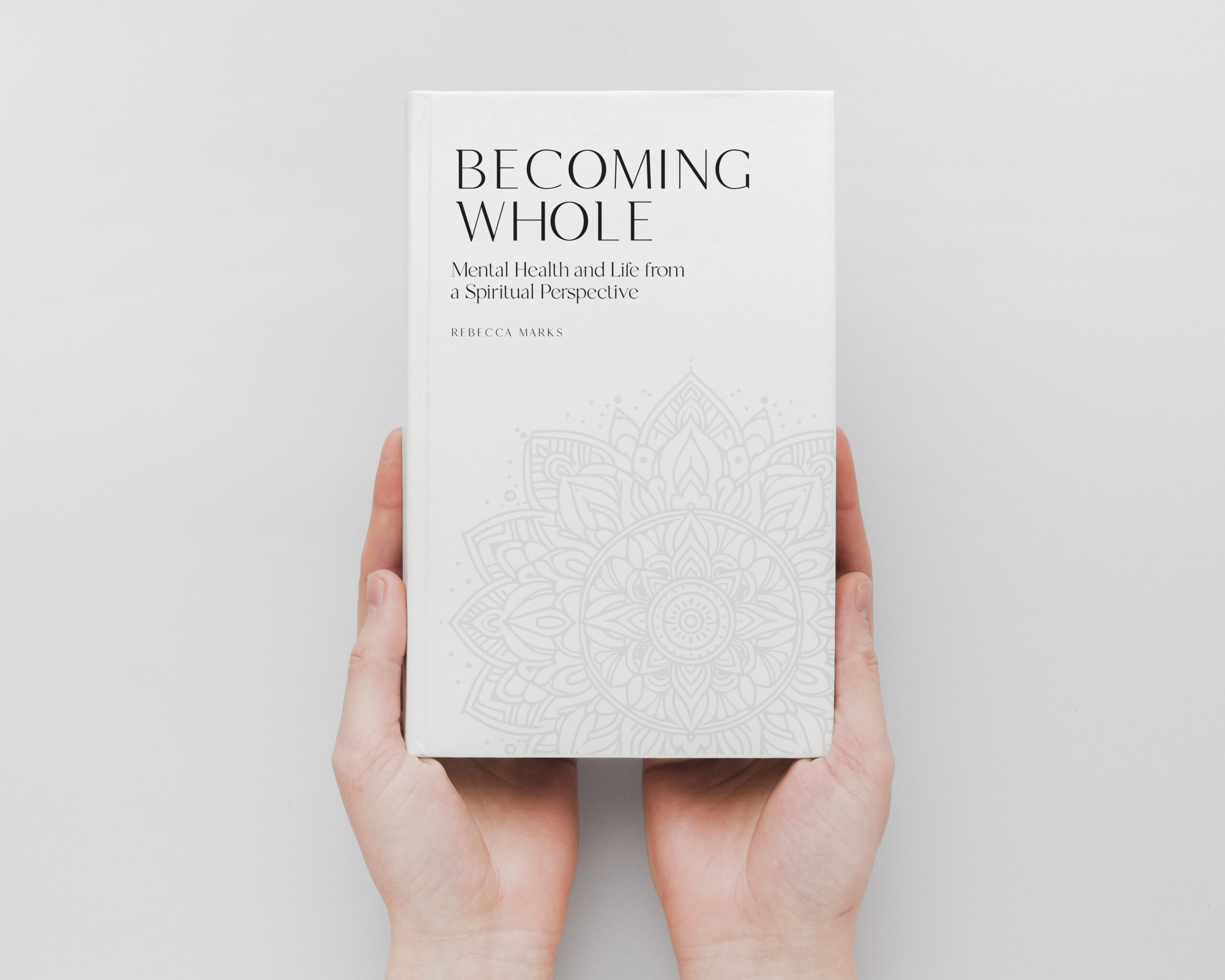
Becoming Whole
Interested in exploring Hermeticism alongside a wide range of other spiritual traditions?
Becoming Whole is The Wellness Society’s practical tool for nurturing your spirituality.
It offers a crash course in:
- Hermeticism
- Vedic thought and Vedanta
- Taoism
- Buddhism
- Sufism
- Paganism
- Kabbalah
- Christian mysticism
- Gnosticism
It identifies the key themes across these traditions and presents them in a way that’s easy to understand without needing years of study.
It includes a PDF, Kindle file, and accompanying guided meditations.


About Rebecca
Rebecca Marks is the founder of The Wellness Society, a social enterprise that has supported thousands on their journey to mental wellbeing.
Her tools have been shared by the NHS and featured by Mind, the UK’s leading mental health charity. She comes from a career in mental health charity management, facilitating peer support programs and co-producing initiatives with service users.
Learn more about our story on the About page.