
When first encountering motivational interviewing (MI), many helping professionals are already familiar with its foundation of respect, curiosity, collaboration, and nonjudgement. One of the first skills helping professionals focus on developing is the use of more (and more effective) open-ended questions, the “O” of the OARS framework in motivational interviewing.
OARS is an acronym that stands for the four fundamental skills used in MI:
- Open-ended questions. Making an inquiry that typically begins with “why,” “what,” or “how”.
- Affirmation. Making supportive statements that acknowledge the good work your client is already doing: "Thanks for being so honest about that difficult situation."
- Reflective listening. Clarifying what you’re hearing from your client and reinforcing their feelings and motivations.
- Summarising. Recapping what you heard your client say to ensure understanding, highlight motivations, and paint the bigger picture.
Open-ended questions are central to the MI approach because they invite clients to explore, elaborate, and connect with their own reasons for change.
Unlike closed questions, which often limit responses to a simple “yes,” “no,” or “maybe,” open-ended questions expand the conversation.
Although the concept itself is straightforward, consistently applying it can be challenging. Practitioners often emphasise that learning MI is not about mastering a script, but about gradually reshaping your natural communication style.
One effective way to build this skill is through everyday practice. For example, by observing your own communication patterns, you might notice a tendency toward advice-giving or reliance on closed questions in your daily interactions.
Shifting toward open-ended questions – even in conversations with family or friends – can help reinforce the habit. For example, replacing a question like “Did you have a good day?” with “What was the best part of your day?” can help encourage more thoughtful responses.
Over time, this shift results in a more natural and consistent use of open-ended, evocative questions.
How to Use Open-Ended Questions Effectively
While open-ended questions are foundational to motivational interviewing, they’re not meant to be used exclusively. Instead, they should be used more frequently than closed questions.
The biggest mistake beginners often make is firing off open-ended questions one after another.
Practitioner: "What brings you here today?"
Client: "My wife made me."
Practitioner: "How do you feel about your diabetes?"
Client: "Fine."
Practitioner: "What would need to change for you to take your medication?"
Client: "I don't know."
So, be mindful that a string of open-ended questions can feel like an interrogation. The key to MI is the integrated use of the four core skills: open-ended questions, affirmations, reflective listening, and summarising.
Practitioner: “What brings you here today?”
Client: “My wife made me.”
Practitioner (reflective): “So you're here because someone else wanted you to come, not because you saw a need yourself.”
Client: “Yeah, I’m not sure I really want to be here.”
Practitioner (open-ended): “What are some things that make you feel concerned about your health right now?”
Client: “Well, my blood sugar’s been all over the place.”
Practitioner (affirmation and reflection): “Okay, so you’ve noticed the impact your diabetes is having, which shows you’re paying attention to your health.”
You can think of MI as a dance between strategic questions (often open-ended) and skilled reflections (which do the heavy lifting).
39 Example Motivational Interviewing Questions
Here are some examples of open-ended MI questions. These aren’t prescriptive “must ask” questions – they’re simply meant to inspire you and get you started. What’s most important is to be authentic and genuine, adapting questions to the client and situation using your own style and language.
Precontemplation Stage Questions
- What needs to happen for you to consider making this change?
- What’s working for you now, without making this change?
- What makes you feel you aren’t ready to make this change right now?
- If you make this change, what would be different?
Contemplation Stage Questions
- What’s one benefit of making this change now? What’s one potential downside of making this change now?
- Connect to any goals they have stated: “How does drinking less connect to your hope of being a more present parent?”
- What might help you move from thinking about making this change to taking action?
Preparation Stage Questions
- What resources and/or support do you need to get started?
- What’s a small step you feel ready to take first?
- What might be an obstacle that gets in your way as you prepare to make this change?
Action Stage Questions
- What next step do you have planned?
- What helped you to be successful this week?
- What challenges came up this week, and how did you face them?
Maintenance State Questions
- What strategies help you most in maintaining this change?
- What are warning signs you might notice if you’re slipping back to the old habit?
- How has your life changed since you started doing X (or stopped doing Y)?
Scaling Questions
- On a scale of 1-10, how important is it to you to make this change now?
- On a scale of 1-10, how confident are you that you can make this change?
- On a scale of 1-10, how ready do you feel to take the first step?
- What would help you move up on the scale?
- Why are you a 5 instead of a 4?
Visioning Questions
- If everything worked out exactly the way you wanted, what would your life look like a year from now?
- Imagine it’s 6 months from now and you’ve achieved the change you’re working on. What does your day-to-day life feel like/look like? How are things different for you?
General Question Examples
- What would a productive week look like for you?
- What’s your relationship with your parents or caregivers like?
- If you set boundaries on time at work, how would that feel for you?
- What would connecting more to your partner look like?
- What concerns do you have about making this change in how you communicate with your partner?
- What helped you when you tried to change habits in the past?
- How would you like things to be different?
- What has helped before when you felt stuck/overwhelmed?
- What would be a good result of making this change in your eating habits?
- Do you anticipate any negative or ‘bad’ results of making this change?
- Who can support you as you make this change to go to bed by 10pm on weeknights?
- What have you tried before to make a change?
- What has helped in the past when you felt stuck?
- When a client gives you information, try to expand on that:
- What else makes it difficult to drink less alcohol?
- What else makes Friday nights so challenging?
- What else does your partner do that supports you in drinking less?
A Universal Prompt for Effective MI
A universally helpful prompt in motivational interviewing is the simple: “Tell me more…”
Although it’s not technically a question, it captures the essence of the MI approach by inviting open, expansive responses.
Rather than directing, fixing, or narrowing the focus, it creates space for the client to guide the dialogue, deepening their own reflections.
Summary
Motivational interviewing (MI) is a collaborative, client-centered approach that helps people explore their motivations for change. At the heart of MI lies the skill of open-ended questioning, which invites clients to reflect, elaborate, and connect with their own goals.
While open-ended questions are foundational, their power is fully realised only when paired with reflective listening, affirmations, and summarising – the other core OARS skills.
By prioritising open-ended questions and practicing attentive listening, you can make your conversations with clients more engaging, empowering, and effective. You've got this!
Free Resources to Support Your Clients
New to our website? At The Wellness Society, we create practical, integrative mental health and wellbeing tools. Our tools are designed to save you time while helping your clients thrive.
Explore our Free Tools Library to access a wide variety of resources you can use in your practice today.


About Laura
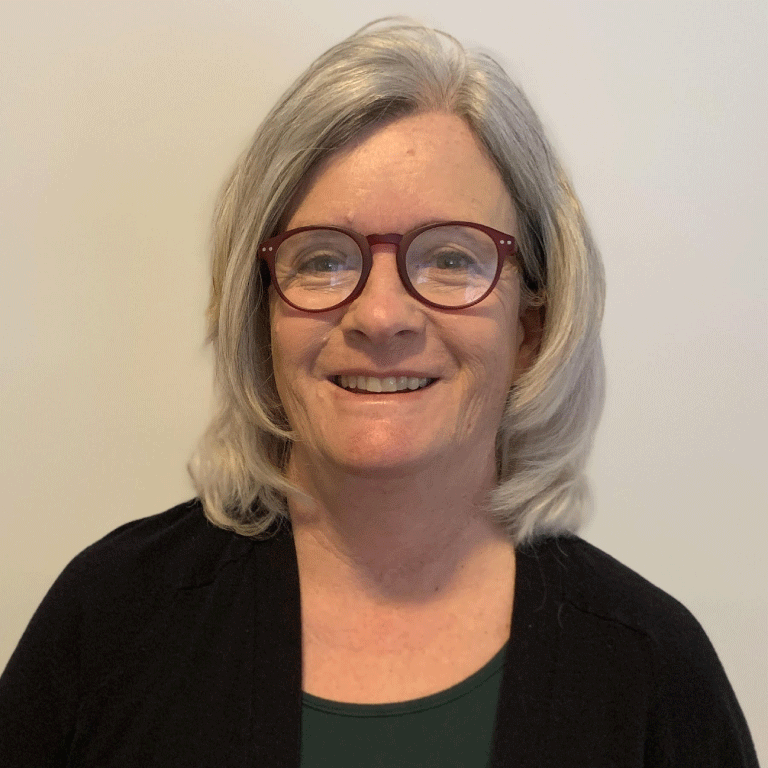
Laura Cleary is a licensed Master Social Worker and a certified National Behavioral Health and Wellness Coach (NBC-HWC).
She has many years of experience as a youth and family community social worker, and currently works full-time as a text based behavioral health coach at Headspace.
You can connect with her via LinkedIn.